

There’s something about December that makes it a month of contradictions. It is a time of cold noses and warm quilts, a month of bright, omnipresent red and gold decorations, while the colours of nature become paler and wetter. Many of us get lost in the frenzy of shopping for Christmas presents, hiding a lethargic melancholy that threatens to wake during what seems to be the most inconvenient of times. But such feelings conceal a necessity to ponder on the burdens of the past year and the hopes for the upcoming one, to dwell on who we have been, and, if needed, to say goodbye to that version of ourselves. Over the centuries, the necessity to feed our inner flame has been translated into rituals, celebrations, legends and even festivals, all of which are about to be explored, with a special focus on Yule, a festival first celebrated 1,500 years ago.
History of Yule
Yule is a pagan winter festival originally celebrated by the Germanic peoples to honour the Winter Solstice, which was considered one of the moments of the year in which the veil that divides our world and the supernatural world was at its thinnest point. The celebrations typically lasted twelve days, from the 21st or 22nd of December (the shortest days of the year, therefore the longest nights) to the 1st or 2nd of January, and initially involved the sacrifice of livestock to various gods, as well as food and ale offerings, feasting and dancing. An example of such rituals would consist of participants putting their hands on a “holy pig,” before swearing various oaths to Freyr (the god of fertility, peace, fair weather, and good harvest) and eventually sacrificing the animal.
“But the meat of the animals was to be boiled and served as food at the banquet. Fires were to be lighted in the middle of the temple floor, and kettles hung over the fires. The sacrificial beaker was to be borne around the fire, and he who made the feast and was chieftain, was to bless the beaker as well as all the sacrificial meat.”
Notes from a collection of sagas about Norwegian and Swedish kings, Heimskringla, translated by R. Hollande
Luckily, the sacrifices eventually turned into less deadly and dramatic ways of asking gods for help and guidance. A tradition people all over the world still unknowingly take part in nowadays is decorating an evergreen tree. Celtic druids believed trees were manifestations of deity, and would decorate them with totems, images of what they wished to obtain in the new year, and candles to persuade the local fairies into participating in the celebrations.
The Yule Log
The tradition of burning of the Yule log consisted of finding the largest possible oak log one could handle, bringing it home (either indoors or outdoors), and slowly burning it over the festival’s twelve days. All sorts of greenery could be used to decorate it, and to avoid setting the house on fire one could simply drill holes in the log and insert some nice candles to then light. Some people would keep a leftover piece of the burnt log for good luck, and to burn it the following year’s celebrations. This specific tradition was observed in honour of Thor, the god that “drives away darkness” and protects common workers, such as farmers. A more modern (and less dangerous) twist of the tradition could be preparing a delicious yule log cake, which can be found in many versions in online recipes.
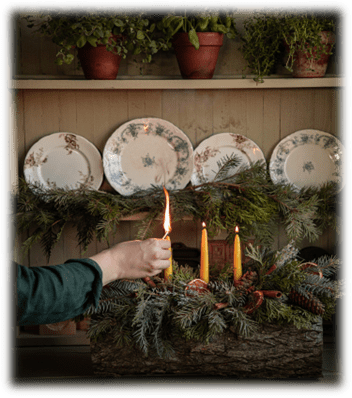
A yule log prepared and photographed by Kaila Lobermeier on her blog “Under a tin roof”
The Yule Cat
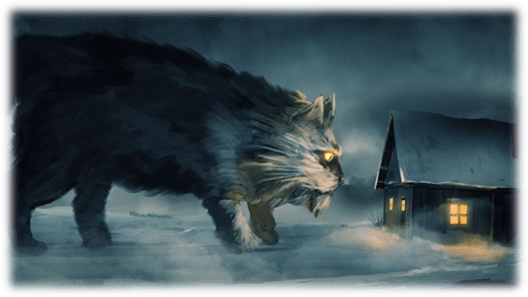
The Yule Cat from the series Monstrum, by PBS Digital Studios
The Yule cat’s origins are shrouded in mystery, although some folklorists suggest it accompanied Saint Nicholas in European tales, while others theorize it was invented by Jón Árnason, an Icelandic author who included the cat in his 1862 collection of folklore. In Árnason’s story, this gigantic cat lives in Iceland’s snowy countryside and comes out during winter to catch poorly dressed people instead of mice. This tale used to work as an incentive for farmworkers to process their employer’s wool: those who managed to finish their job would receive new clothes, while the others would not…therefore taking the risk of becoming prey for the Yule cat. Nowadays, the Yule cat’s story is told to children to encourage them not to be lazy and to wear appropriate and clean clothes.

Statue in Iceland dedicated to the Yule cat – copyright credits to L.A. Vocelle
Irish mythology
“Angus hath come – the young the fair,
The blue-eyed god with golden hair,
The god who to the world doth bring,
This morn the promise of the spring”
Song about Aengus, composed by a bard
Before it was called Yule by the Germanic peoples, the winter solstice had been the protagonist of myths and gatherings in numerous areas of the world. In Ireland, where the solstice is also called Grianstad an Gheimhridh, the druid god Dagda and his son Aengus act as powerful influences in the balance between the old and the new, darkness and light. The Dagda is a worthy warrior and king, associated with wisdom, agriculture, and vigour. He’s often portrayed as a highly intelligent being and leads existence following a carpe diem philosophy that frequently renders him the cheeky protagonist of humorous stories and tales. He represents the old year and experience, whereas his son, Aengus, incarnates youth and love. Aengus’s birth is mystical and divine: he’s conceived and born on the same day, and for this reason, he’s called “Maccan Óc,” meaning “young son.” Aengus is a dreamer who exists permanently in the springtime of life: for this reason, he embodies the new year and its vast opportunities. He’s described as an excellent harp player, with four birds constantly following him, ready to travel carrying his messages of love into the hearts of the young, earning themselves the nickname “Aengus’ kisses.” According to legends, the Dagda and his son lived in Brú na Bóinne, where the former allegedly built the astonishing Newgrange; a monument more ancient than the pyramids, currently classified by archaeologists as a passage tomb, but effectively too complex to be reduced to a single definition.
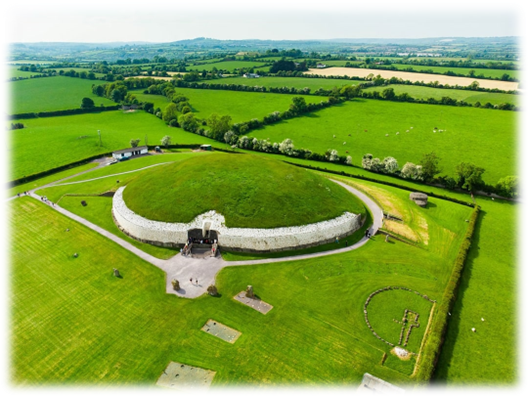
Newgrange seen from above, photo provided by Daly’s Inn
Although several human remains have been found over the years, the monument keeps and generously shares traces of having lived as a sacred temple, where the local people (mostly farmers) organized rituals and celebrations. During the Winter Solstice, people would gather to witness the sunlight as it punctually flooded the inner chamber of Newgrange through a roof box at sunrise, wisely and relentlessly speaking to its visitors still to this day.

Picture by Kate Hickey, The sunlight enters the passage at the Winter Solstice
This year, after decluttering your space to let go of the old, remember to take care of your inner flame as you head towards the new year. Consider treating yourself with a fancy new outfit during Yule, and watch out for birds hovering near you, for they might carry a love message from an Irish God.
 Moon Harvest
Devi effettuare l'accesso per postare un commento.